


Project at a glance
- Problem
- Hotel check-in involved lengthy registration forms, queues and disconnected systems.
- My role
- Product Design, research and opportunity validation.
- Team
- Victor Kato, Michelle Musafir, Caio Santos, Cauê Melo and Rayssa Vanucci.
- Period
- Research began in February 2022; case documented in March 2023.
- Outcome
- The project was stopped because its regulatory dependency, rising totem costs and opportunity cost made it a lower priority for the company.
Exploring a simpler hotel check-in experience
Fast Check-in explored a way for guests to submit registration details before arriving at a hotel. The concept would reuse existing guest information to help prepare the National Guest Registration Form (FNRH), reducing manual entry for guests and hotel staff.
Challenges
Lengthy registration forms can slow down arrival and create queues, especially when groups check in together. We explored whether completing these steps before arrival could make the process easier for guests and hotel staff.
Project exploration
We structured the exploration around four activities:
1 - Problem identification
-
Queues at reception
-
Lengthy registration forms
-
Lengthy process
-
Limited integration with hotel systems
2 - Research
-
User interviews
-
Hotel research
-
Interviews with online check-in providers
-
Interviews with property management system (PMS) providers
3 - Business model and validation of hypotheses
-
Business Model Canvas
-
Hypothesis prioritization
4 - Validation with the hotels
-
Landing page
-
Interviews with hotels
-
Assessment of the development timeline
-
Decision not to pursue development
Prototype: exploring the check-in flow
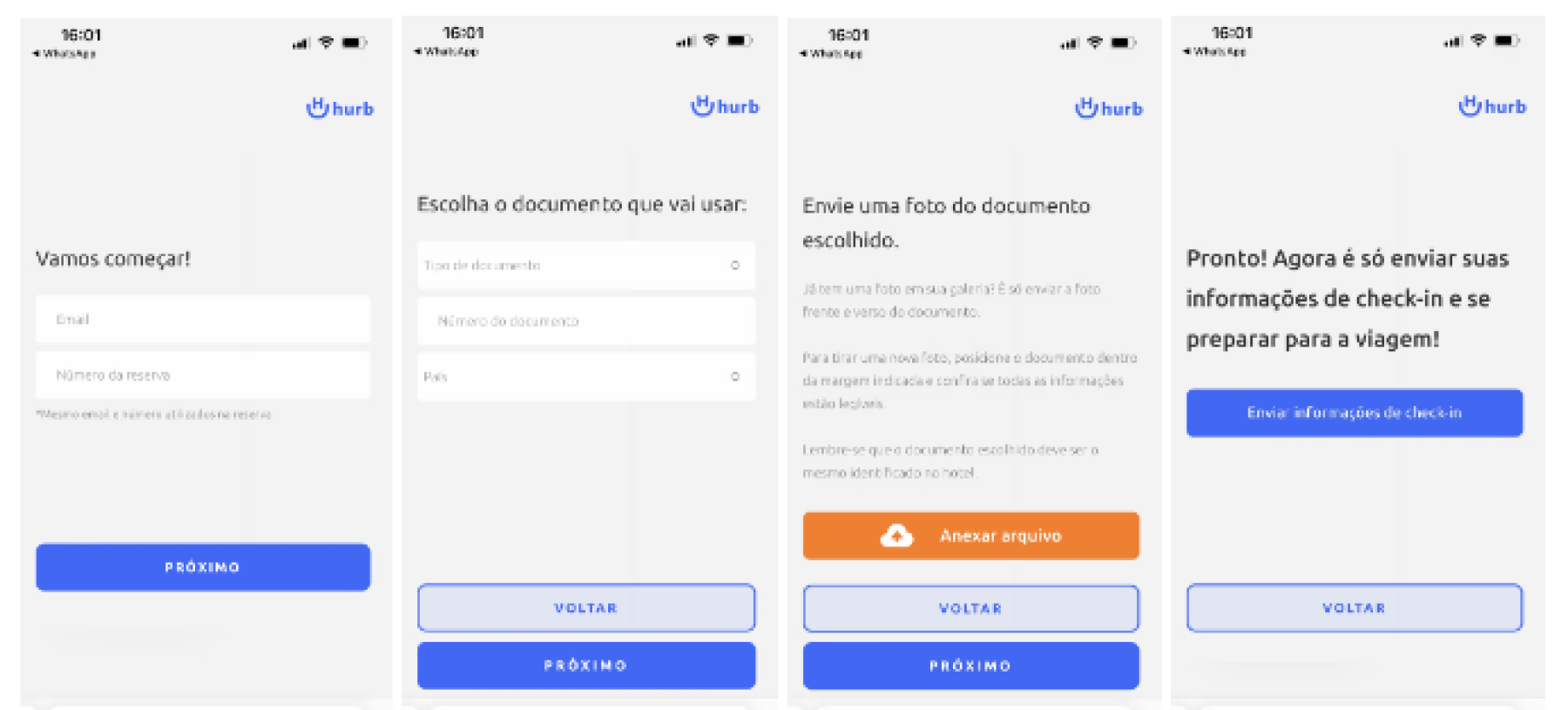
Why we stopped development
Research began in February 2022, when the team saw an opportunity to improve online check-in. The concept depended on an expected legal change that would allow guests to check in at a kiosk, provided the process preserved the safeguards of a physical check-in: confirming the guest’s identity, checking whether children were travelling and verifying the required documentation.
We studied the workflows, spoke with online check-in providers, PMS providers, internal teams and partner hotels, and explored a business model in which the kiosks would be offered to hotels at no cost in exchange for discounts and other benefits for the travel agency.
As the project progressed, the cost of the kiosks increased and the regulatory dependency remained unresolved. The opportunity cost also grew: the company had other priorities and the project no longer received the budget and attention required to move forward. We therefore decided to stop development and redirect the team’s effort to a higher-priority opportunity.
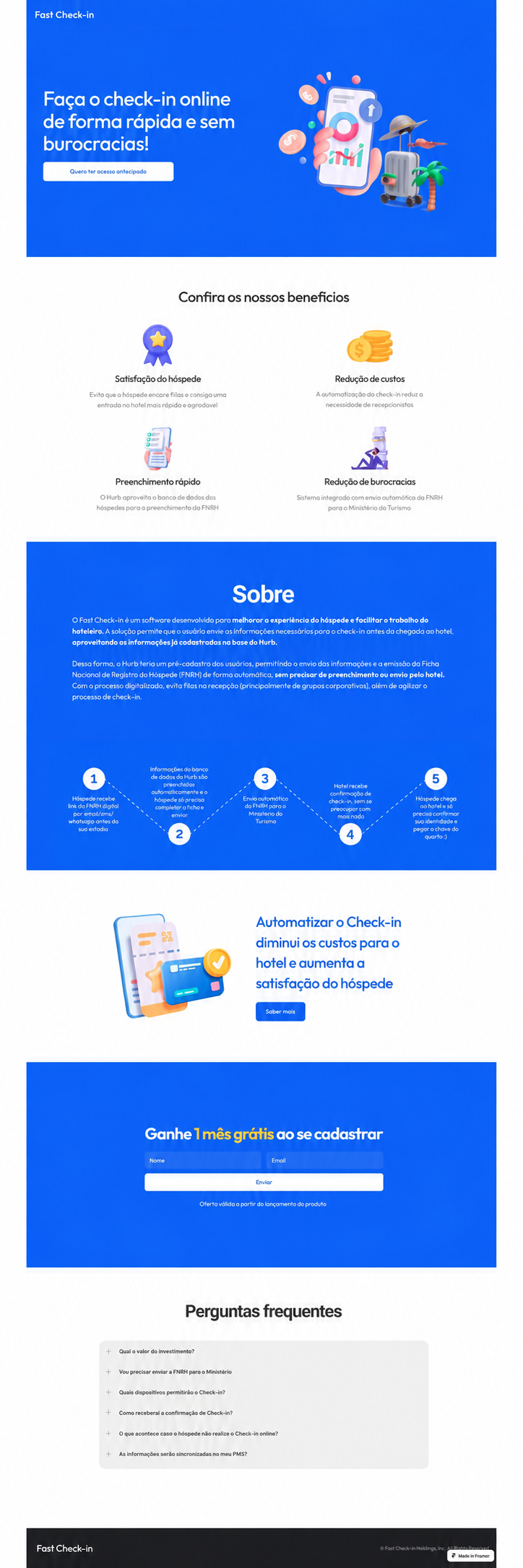
Landing page concept
The landing page supported a final round of concept validation with hotels. This static reference has the company logos removed; it contains no live forms or external links.
Victor Kato
Head of R&D and Product Designer
Industrial Design - PUC-RJ - Pontifical Catholic University of Rio de Janeiro
Michelle Musafir
Product Designer
Industrial Design - PUC-RJ - Pontifical Catholic University of Rio de Janeiro
Caio Santos
Research and development engineer
Nuclear Engineering - UFRJ - Federal University of Rio de Janeiro

Cauê Melo
Software Engineer
Information Systems - Unirio - Federal University of the State of Rio de Janeiro
Rayssa Vanucci
Operation Manager
International Relations - PUC-MG - Pontifical Catholic University of Minas Gerais